Business Setup in UAE Free Zones – A 2026 Legal Guide
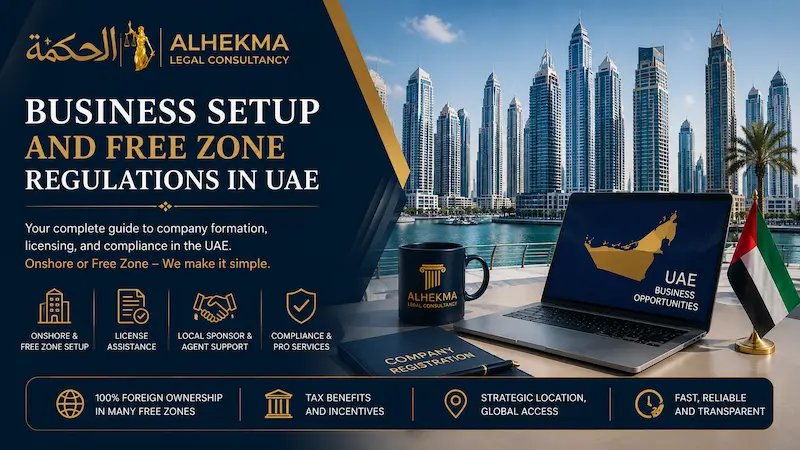
The UAE’s free zones remain the top choice for international entrepreneurs in 2026, offering 100% foreign ownership, zero corporate tax on qualifying activities, and streamlined licensing. However, choosing the right free zone and legal structure is critical for long‑term success. ALHEKMA Legal Consultancy – led by former judicial officers – walks you through everything you need to know.
1. Free Zone vs. Onshore – Which One Is Right for You?
Free zone companies are ideal for international trade, e‑commerce, consulting, manufacturing, and logistics. Benefits include:
- 100% foreign ownership (no local sponsor required)
- 0% corporate tax for qualifying activities (subject to compliance with UAE Corporate Tax Law)
- Full repatriation of capital and profits
- Customs duty exemptions on imports/exports within the free zone
Onshore (mainland) companies can trade directly within the UAE market without restrictions. However, many commercial activities still require a local service agent (not a sponsor, but a 51% local partner is no longer mandatory for most activities under the Commercial Companies Law). The choice depends on your target market.
Our recommendation: If your customers are primarily outside the UAE, start with a free zone. If you need to trade directly with the local UAE market (e.g., retail, restaurants, construction), an onshore license may be better. We help you model the tax and operational implications. Learn more about our business setup advisory →
External resource: DMCC – Dubai Multi Commodities Centre | ADGM – Abu Dhabi Global Market
2. Licensing Categories & Typical Costs
Free zone licences fall into several categories. Choosing the wrong one leads to compliance fines or inability to perform certain activities.
- Commercial Licence: For trading, general commerce, logistics, and re-export. Example: DMCC Commercial Licence – approx. AED 25,000–50,000 all-in.
- Professional / Service Licence: For consulting, marketing, legal services, IT services. Example: DIFC Non-Regulated Licence – approx. AED 15,000–30,000.
- Industrial Licence: For light manufacturing, assembly, packaging. Example: JAFZA Industrial Licence – higher capital requirements.
- E‑commerce Licence: Tailored for online retail. Many free zones (e.g., Dubai South) offer packages under AED 15,000.
Costs vary significantly by free zone (RAKEZ, SHAMS, DSO, DIC, ADGM, etc.). We provide a side‑by‑side cost comparison table during your free consultation.
3. The Setup Process – Step by Step (5–10 working days)
With our legal assistance, the process typically follows these steps:
- Select free zone and licence type – based on your business model.
- Reserve trade name – compliance with UAE naming conventions.
- Submit incorporation application – passport copies, business plan, etc.
- Lease a physical office or flexi‑desk – required for visa quotas.
- Obtain initial approval – from the free zone authority.
- Sign company formation documents – often digitally.
- Receive licence and apply for visas – shareholder, employee, dependents.
- Open corporate bank account – we assist with documentation and introductions.
We handle all government portals, attestations, and follow‑ups. Download our free checklist at the end of this article.
4. Visas and Bank Accounts – What to Expect in 2026
Visa quotas: The number of residence visas you can sponsor depends on the office size. A flexi‑desk typically allows 1-3 visas. An office of 500 sq ft may allow 5-10 visas. We can advise on optimal office size to meet your team needs.
Bank account opening: Stricter AML/KYC checks apply in 2026. Banks require audited financials (for older companies), source of funds declarations, and sometimes a minimum balance (AED 10,000–50,000). We have preferred relationships with banks like Emirates NBD, Mashreq, and RAKBANK to fast‑track applications. See our AML compliance services →
Corporate tax note: Free zone persons that comply with regulatory requirements and do not conduct business with mainland UAE may remain at 0% corporate tax. However, qualifying free zone persons (QFZPs) must meet specific conditions under Cabinet Decision No. 55 of 2026. We help you file the election.
Frequently Asked Questions About Free Zone Business Setup
Can I live in Dubai with a free zone visa?
Yes. Free zone companies can sponsor residence visas for shareholders, employees, and their families. The visa is valid for 2–3 years and renewable.
Do free zone companies pay corporate tax in 2026?
Qualifying free zone persons (QFZPs) can benefit from a 0% corporate tax rate on qualifying income, provided they meet compliance conditions. Non-qualifying income may be subject to the standard 9% rate.
Can a free zone company open a bank account in the UAE?
Yes, but stricter AML/KYC checks apply. We assist with bank account opening as part of our service, providing a complete KYC package and introductions to relationship managers.
What is the cheapest free zone in UAE?
RAKEZ and SHAMS often have packages starting from AED 12,000–15,000 all-in. However, cheaper is not always better – consider proximity to your market and visa quotas.
📄 Free Download: UAE Free Zone Setup Checklist
Get our 10-page PDF checklist covering:
– Required documents per free zone
– Step‑by‑step timeline
– Bank account document checklist
– Corporate tax compliance reminders
© ALHEKMA Legal Consultancy – free for personal use