
The Cost of Weak Contracts in UAE Business
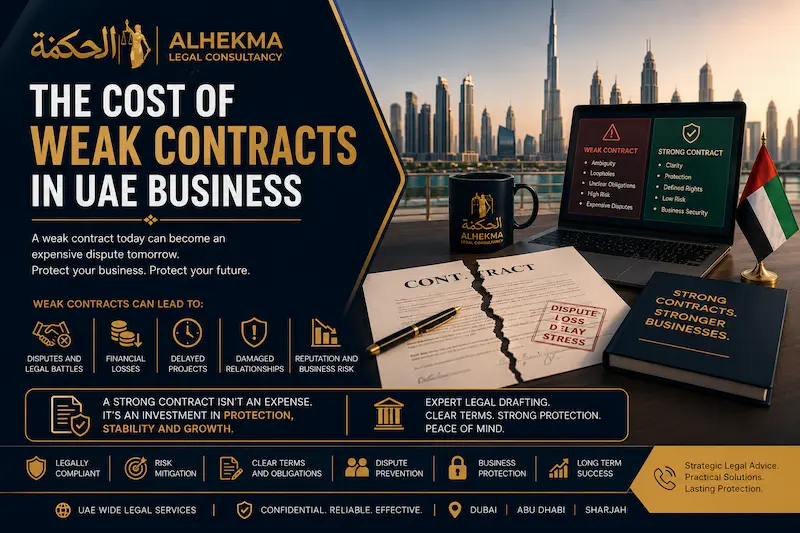
In UAE commercial litigation, the outcome of most disputes is determined not by which party is "right" in a moral sense, but by what the contract actually says — and what it fails to say.
Learn more about our commercial contract services →
1. The Civil Law vs. Common Law Gap
The most fundamental source of contract weakness in the UAE is the gap between common law drafting conventions and civil law interpretation principles.
In the UAE's Civil Law system, contract interpretation is governed by Articles 258–270 of the UAE Civil Code, which prioritize:
- The true intention of the parties over the literal meaning of words
- The context and circumstances of the contract's formation
- Good faith in both formation and performance
- Custom and usage in the relevant trade or industry
2. The Seven Most Expensive Contract Weaknesses
Weakness 1: Ambiguous Payment Terms
Contracts that specify amounts but not payment mechanics. Under the UAE Civil Code, a creditor must make a formal demand (interpellation) before a debtor is in default, unless the contract specifies a fixed due date.
Weakness 2: Inadequate Scope of Work Definitions
Under Article 178 of the UAE Civil Code, the object of a contract must be specified or specifiable. Vague descriptions render contracts unenforceable or create evidentiary challenges.
Weakness 3: Missing Force Majeure Provisions
Under Article 287 of the UAE Civil Code, force majeure is defined as an event that is unpredictable, unavoidable, and external. This differs from common law interpretations. The Civil Code also recognizes "exceptional circumstances" (hardship) — a distinct concept requiring separate clauses.
Weakness 4: Unenforceable Penalty Clauses
Under Article 390 of the UAE Civil Code, penalty clauses are enforceable but subject to judicial reduction if they exceed actual damage. This differs materially from common law jurisdictions.
Weakness 5: Inadequate Termination Provisions
The UAE Civil Code requires that contract termination be justified. Arbitrary termination — even if technically permitted by the contract — can expose the terminating party to damages.
Weakness 6: Jurisdiction and Governing Law Confusion
Contracts that specify "UAE law" without clarifying which jurisdiction (Dubai Courts, DIFC Courts, ADGM Courts) create uncertainty. A contract specifying "Dubai Courts" requires Arabic translations of all evidence; DIFC Courts permit English proceedings.
Weakness 7: Missing IP and Confidentiality Provisions
UAE IP law provides protections, but default ownership rules may not align with commercial expectations. Without explicit IP assignment provisions, default legal positions may favor the creator.
Learn more about intellectual property services →
3. The Real Cost: A Quantified View
| Weakness | Avg. Dispute Cost | Timeline | Likelihood |
|---|---|---|---|
| Ambiguous payment terms | AED 100K–500K | 6–12 months | Very High |
| Vague scope definitions | AED 200K–2M | 12–24 months | High |
| No force majeure/hardship | AED 500K–5M+ | 12–36 months | Event-dependent |
| Unenforceable penalties | AED 50K–300K | 3–12 months | Medium |
| Poor termination provisions | AED 150K–1M | 6–18 months | High |
| Jurisdictional confusion | AED 100K–500K | 3–12 months | Medium |
| Missing IP/confidentiality | AED 200K–3M+ | 12–24 months | Medium-High |