
Debt Collection and Enforcement in the UAE – Strategies for Businesses (2026)
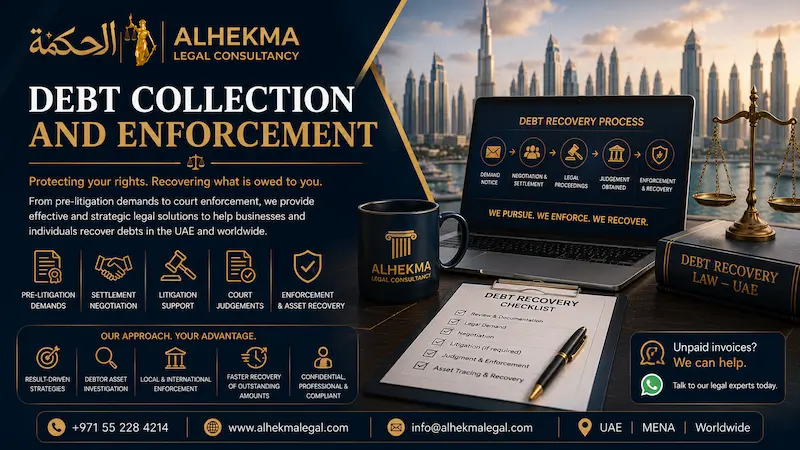
Unpaid invoices can cripple a business. Fortunately, the UAE legal system provides robust mechanisms for debt recovery, ranging from amicable negotiation to court‑ordered enforcement. ALHEKMA Legal Consultancy outlines the most effective strategies for collecting debts while maintaining commercial relationships.
1. Pre‑Litigation Demands and Legal Notices
Before filing a court case, a formal legal notice is sent to the debtor. This alone prompts payment in over 80% of cases. Our firm drafts precise, legally sound notices that signal seriousness and create a clear record for future litigation.
Key elements of an effective demand letter in the UAE:
- Clear identification of the debt amount and due date
- Reference to the underlying contract or invoice
- Explicit warning of legal action if payment is not made within a specified period (e.g., 7–14 days)
- Delivery via registered post or notary public to prove receipt
2026 note: Electronic legal notices sent via registered email or the UAE's unified digital notarisation platform are now admissible as evidence, provided sender identity is verified. We can advise on the most effective delivery method for your case.
Learn more about our debt recovery services →
2. Payment Order – A Fast‑Track Procedure
The UAE courts offer a summary proceeding called a Payment Order for undisputed debts. This allows creditors to obtain an enforceable judgment in a fraction of the time of a full civil lawsuit – often within 30 to 45 days from filing.
Requirements for a payment order:
- The debt must be liquidated (fixed amount) and due
- The debtor must not have a valid counterclaim
- You must provide clear documentary evidence (contract, invoices, delivery proof)
2026 update: The UAE Courts now accept digitally signed contracts and electronically stored invoices as prima facie evidence, streamlining the process. We assess your case and recommend the quickest route to recovery.
3. Bounced Cheques – Criminal and Civil Remedies (2026 Update)
Following the decriminalisation of bounced cheques (Federal Decree‑Law No. 14 of 2020), most cheque‑related cases are now civil matters. However, a bounced cheque still constitutes strong evidence of debt and can be used to obtain a quick judgment.
When can criminal action still be pursued in 2026?
- If the drawer issued the cheque without sufficient funds or stopped payment with fraudulent intent
- If the drawer failed to satisfy the judgment debt within the grace period set by the court
- In cases of forged or stolen cheques
Practical strategies for cheque debt recovery:
- File a civil claim relying on the bounced cheque as evidence of debt (fast track possible)
- Request a travel ban or asset freeze against the debtor (available in cases where fraud is alleged or a final judgment exists)
- Pursue a criminal complaint for fraud if evidence of deceit exists – the threat of a travel ban often compels payment
We assess your cheque case and recommend the most effective legal path. Read about criminal defense for cheque cases →
4. Enforcement of Judgments and Asset Tracing
Once a judgment is obtained, we enforce it through:
- Bank account attachment: Court order to freeze and seize funds from the debtor's UAE bank accounts
- Property seizure: Attachment of real estate, vehicles, or movable assets
- Salary garnishment: Up to 50% of the debtor's wages (subject to minimum subsistence rules)
- Third‑party garnishment: Seizing funds owed to the debtor by their customers or employers
Cross‑border enforcement (2026 update): The UAE has strengthened enforcement of foreign judgments through bilateral treaties with over 30 countries, including the UK, France, India, and China. Under the new Civil Procedures Law amendments (2025), foreign judgments are now enforceable within 60 days if the originating court provides reciprocal treatment. We coordinate with local counsel worldwide to trace and recover assets globally.
Asset tracing: Our team works with forensic accountants and investigators to identify hidden assets, including offshore holdings, through public registries and court‑authorised discovery.
5. Frequently Asked Questions
How long does debt recovery take in the UAE?
A simple payment order can be obtained in 30–45 days. A full civil case may take 6–12 months from filing to judgment, plus enforcement time. Pre‑litigation demand letters resolve about 80% of cases within 2 weeks, avoiding court entirely.
Can I get a travel ban against a debtor in the UAE?
Travel bans are generally not automatic for civil debts unless a court orders it. However, if the debt arises from a bounced cheque and fraud is alleged, a criminal complaint can lead to a travel ban. For final civil judgments, you may request a travel ban as part of enforcement proceedings.
What is the statute of limitations for debt recovery in the UAE?
The general limitation period for commercial debts is 10 years under the UAE Civil Code. However, for specific contracts (e.g., insurance, banking), shorter periods may apply. We advise consulting us to avoid prescription issues.
Can I recover legal costs and collection fees from the debtor?
Yes, the court can award legal fees, expert fees, and a portion of the collection costs (subject to the court's discretion). We always claim these in our filings.
How do I enforce a foreign judgment in the UAE?
Under the 2025 Civil Procedures Law amendments, foreign judgments from countries with reciprocal enforcement treaties can be recognised and enforced within 60 days. The process requires a petition to the Court of Cassation with authenticated copies. We handle the full process.
📄 Free Download: UAE Debt Recovery Action Plan 2026
Get our comprehensive 8‑page PDF covering:
– Step‑by‑step pre‑litigation demand letter template
– Payment order checklist and required documents
– Bounced cheque decision flow (criminal vs. civil)
– Judgment enforcement timeline and forms
– Cross‑border enforcement treaty reference table
© ALHEKMA Legal Consultancy – free for personal use