
The New Era of Corporate Governance in UAE
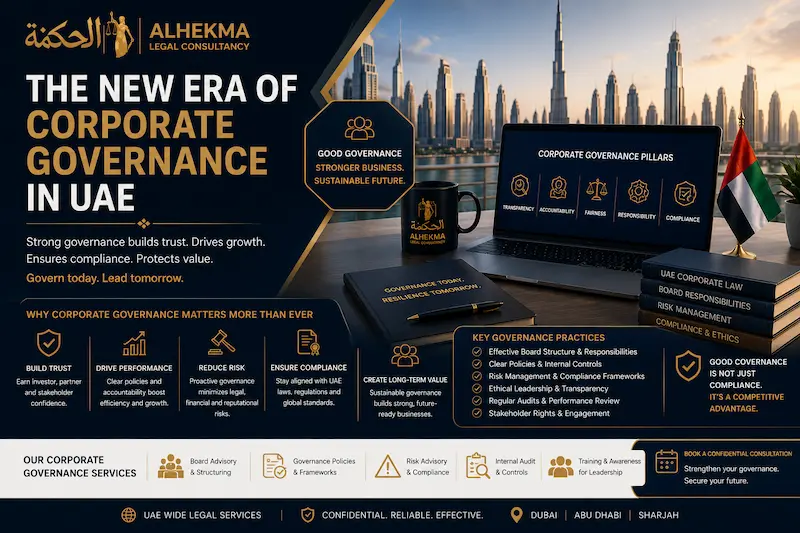
Federal Decree-Law No. 32 of 2021 introduced enhanced governance requirements, clarified director liabilities, and established a statutory framework for shareholder rights. Combined with DIFC and ADGM governance codes, the landscape has fundamentally shifted.
1. What Has Changed: The Legislative Framework
Federal Decree-Law No. 32 of 2021
- Director liabilities — Enhanced fiduciary duties: duty of care, duty of loyalty, duty to act in best interests. Personal liability for losses caused by negligence or breach.
- Shareholder rights — Enhanced minority shareholder rights, clearer rules on related-party transactions, strengthened protections against oppressive conduct.
- Transparency — Mandatory financial reporting, disclosure of related-party transactions, external audit requirements.
DIFC and ADGM Governance Frameworks
DIFC operates under the DFSA Governance Framework and DIFC Companies Law. ADGM operates under FSRA Governance Framework and ADGM Companies Regulations. Both follow common law principles familiar to international investors.
2. The Five Pillars of Effective Governance
Pillar 1: Board Structure and Composition
Board size appropriate to company scale. At least one independent director. Skills matrix covering legal, financial, operational, and industry expertise. Term limits and rotation.
Pillar 2: Decision-Making Authority
Implement a "reserved matters" schedule: decisions reserved to shareholders, decisions reserved to the board, decisions delegated to management. Without this, individual managers may bind the company without proper authority.
Learn more about corporate lawyer services →
Pillar 3: Financial Oversight and Reporting
Annual budgeting and variance analysis. Applicable reporting standards (IFRS, UAE FRS). Internal controls over cash management, procurement, and payroll. External audit. Tax compliance.
Pillar 4: Related Party Transaction Management
Maintain a register of related parties. Require full disclosure. Board/shareholder approval with interested party abstaining. Ensure arm's length terms. Document comprehensively.
Pillar 5: Compliance and Risk Management
Designated compliance function. Risk register. Regular board reporting. Ongoing training. External advisory for specialist areas.
Learn more about regulatory compliance →
3. Director Liability: What Every Director Must Know
- Civil liability — Damages for breach of fiduciary duties, violation of law, or negligent management
- Regulatory liability — Sanctions for corporate tax, AML, data protection, or securities law violations
- Criminal liability — Prosecution for fraud, embezzlement, bounced cheques, or safety violations
The best defense: Documented board processes, professional advice on material matters, compliance programs, independent financial verification.
4. Governance for Family Businesses
Family businesses face unique challenges: generational transitions, family employment policies, succession planning, and wealth diversification. Implement a family constitution or charter, a family council, clear employment policies, professional board representation, and regular family assemblies.
Key Takeaways
- Corporate governance has been redefined by the new Companies Law and DIFC/ADGM frameworks
- Five pillars define effective governance: board structure, decision-making authority, financial oversight, related-party management, compliance
- Director liability is real and increasing
- Good governance is a competitive advantage — it builds investor confidence and reduces dispute risk
5. Frequently Asked Questions
Does the new Companies Law apply to free zone companies?
Application varies by free zone. Some apply the Federal law directly; others have their own regulations. DIFC and ADGM operate under their own company laws.
Are SMEs required to have a formal board?
The Companies Law requires certain company types to have specified management structures. For smaller companies, governance is flexible but the principles remain essential.
How often should a UAE company hold board meetings?
Best practice for private companies is quarterly, with additional meetings for material decisions. Every meeting should have documented agenda, quorum, and minutes.
Can a company indemnify directors against liability?
Yes, to an extent. Indemnification cannot cover fraud, willful misconduct, or violations of law. Directors' and Officers' (D&O) insurance is available and recommended.
Is Your Governance Framework Adequate?
Our team — including former judges — can conduct a governance review and help you implement a protecting framework.
Book a Free Governance Review Message Us on WhatsApp