
Wills, Inheritance, and Asset Succession for Expats in the UAE – 2026 Legal Guide
- 1. What Happens If You Die Without a Will in the UAE (2026)
- 2. DIFC Wills – Common‑Law Framework for Non‑Muslims
- 3. DIFC Will Types – Full, Property, Financial Assets, Business Owners, Guardianship, Digital Assets
- 4. ADGM Wills – Hybrid Common‑Law Registration + ADJD Probate
- 5. Guardianship of Minor Children – The Most Critical Reason for a Will
- 6. DIFC Foundation – An Alternative to Traditional Wills for HNW Families
- 7. Assets Outside the UAE – Coordinating Multiple Wills
- 8. Key 2026 Legal Changes – Intestacy Rules, Heirless Assets, Age of Majority
- 9. Costs and Registration Process (2026)
- 10. Frequently Asked Questions
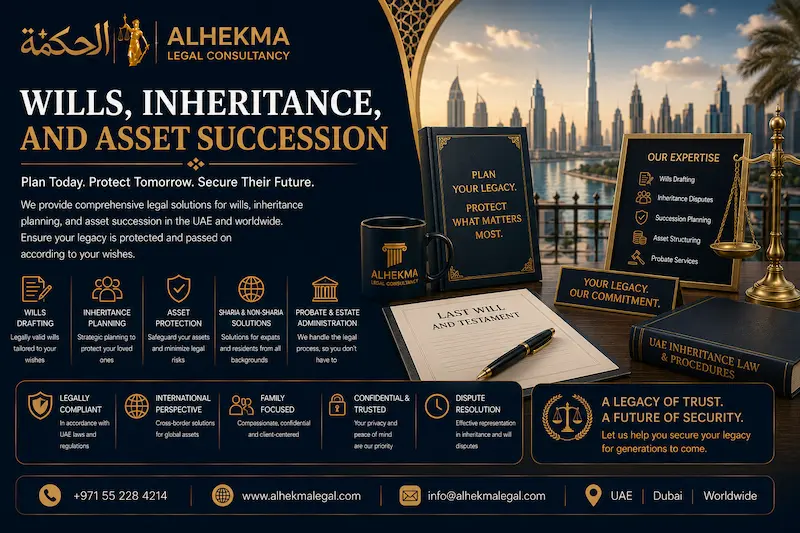
One of the most overlooked aspects of expatriate life in the UAE is succession planning. Without a valid will, your assets may be frozen and distributed according to default statutory rules that may not align with your wishes. This 2026 guide, prepared by former judges at ALHEKMA Legal Consultancy, explains how to secure your legacy and protect your family. Learn more about our family law and inheritance services →
1. What Happens If You Die Without a Will in the UAE (2026)
Banks and accounts are frozen immediately. When an expatriate passes away without a valid registered will, UAE bank accounts – including jointly held accounts – are typically frozen by the financial institution until a court order is issued. This process can take several months, leaving dependants without access to funds during a critical period.[reference:0] Real estate holdings similarly remain locked until a competent court appoints an administrator and issues a distribution order.
Default inheritance rules for non‑Muslims. Under Federal Decree‑Law No. 41 of 2022 (Civil Personal Status Law), effective from 1 February 2023, if a non‑Muslim expatriate dies without a will: the surviving spouse inherits 50% of the estate, and the remaining 50% is divided equally among the children (male and female children inherit equal shares).[reference:1] If the deceased has no children, the estate passes to parents and siblings in defined proportions. While this is a significant improvement over the previous default application of Sharia‑based distribution, it still may not reflect your personal intentions – particularly in blended families, cohabiting couples, or cases where you wish to leave assets to individuals outside the immediate statutory line.
2026 amendment: Heirless assets go to charity. Under the updated Civil Transactions Law effective 2026, if a non‑Muslim expatriate dies without a will and without identifiable legal heirs, their UAE‑based assets will be converted into a charitable endowment (waqf), administered by competent authorities for public interest purposes.[reference:2] This means that without a will, your assets could end up going to charity rather than to the people you care about. Business owners, investors, and property holders are particularly exposed, as company shares, real estate, and bank accounts all fall within the scope of the law.
Guardianship defaults to the court. Without a will, guardianship of minor children is decided by the court, which may not align with your wishes.[reference:3]
Age of majority reduced to 18 (effective June 2026). From June 2026, Federal Decree‑Law No. 25 of 2025 will lower the age of majority in the UAE from 21 lunar years to 18 Gregorian years.[reference:4] Minors aged 15 (Gregorian years) can apply for court approval to manage inherited assets, supporting early financial independence while maintaining judicial oversight.[reference:5]
2. DIFC Wills – Common‑Law Framework for Non‑Muslims
The Dubai International Financial Centre (DIFC) Courts Wills Service Centre was specifically created to allow non‑Muslims to register wills under a common‑law framework within the DIFC.[reference:6] Governed by common‑law principles and administered through the DIFC Courts, they offer clarity in a jurisdiction where uncertainty can otherwise arise quickly after death.[reference:7]
Key features of DIFC Wills:
- English‑language will structure and registry process[reference:8]
- Dedicated will types for different asset classes (Full Will, Property Will, Financial Assets Will, Business Owners Will, Guardianship Will, Digital Assets Will)[reference:9]
- Virtual registration options for certain will types[reference:10]
- Clear appointment of executors and guardians for minor children[reference:11]
- Once a will is registered, it can be enforced efficiently through the DIFC Courts, which operate on common‑law principles similar to England and Wales[reference:12]
Under Dubai Law No. 15 of 2017, a dedicated Register of Wills of non‑Muslims operates at both the Dubai Courts and the DIFC Courts, providing two distinct pathways for estate planning.[reference:13]
3. DIFC Will Types – Full, Property, Financial Assets, Business Owners, Guardianship, Digital Assets
DIFC offers different will formats depending on asset types and planning goals. A Full Will is usually chosen when you want one document for different asset classes and guardianship, while narrower wills suit more focused cases.[reference:14]
- Full Will: Mixed UAE assets plus, if needed, guardianship. Ideal for families with several asset classes.
- Property Will: Shares in up to five UAE real properties. Best for property‑focused investors.
- Financial Assets Will: UAE bank and brokerage accounts (up to ten accounts). Suitable for account‑focused planning.
- Business Owners Will: Shares in up to five UAE companies. Designed for founders and shareholders.
- Guardianship Will: Guardianship appointments only for parents focused solely on children's care.
- Digital Assets Will: Eligible digital holdings via DIFC structure for holders of significant digital assets.
Practical scenarios where DIFC Wills are a good fit: If you own an apartment in Dubai and hold savings in a UAE bank account, DIFC gives you an English‑language route to structure property and financial planning clearly. If you own shares in a UAE company, the Business Owners Will is specifically designed for company‑share succession. If you have property, UAE accounts, and minor children, a Full Will combines asset planning with guardianship in one structure.[reference:15]
4. ADGM Wills – Hybrid Common‑Law Registration + ADJD Probate
The Abu Dhabi Global Market (ADGM) Wills framework operates through a hybrid legal structure that combines common‑law principles with local UAE probate and enforcement mechanisms.[reference:16] ADGM wills are drafted and registered under the common‑law framework of ADGM, following internationally familiar concepts such as testamentary freedom, executor authority, and structured succession planning.[reference:17]
Key differences from DIFC Wills:
- Registration: ADGM Notary Public registers and authenticates wills under common‑law principles.
- Probate: Unlike DIFC, probate is not handled by ADGM Courts. Instead, probate is conducted through the Abu Dhabi Judicial Department (ADJD), making ADGM wills a hybrid solution that combines common‑law planning with local enforcement.[reference:18]
- Bilingual requirement: ADGM requires the will to be translated into a bilingual format (Arabic and English).[reference:19]
This model offers a balance between legal familiarity and enforceability, combining structured succession planning with local recognition and reducing jurisdictional conflicts.[reference:20] ADGM wills are particularly attractive to non‑Muslim expatriates seeking international legal familiarity while ensuring enforceability within the UAE's local court system.
5. Guardianship of Minor Children – The Most Critical Reason for a Will
For parents, this is often the most critical element of any legal plan. If both parents are unable to care for their children, the question of guardianship becomes immediate. Without formally documented arrangements, this responsibility may fall to the local courts, potentially creating uncertainty at a highly sensitive time.[reference:21]
Under Dubai Law No. 15 of 2017, non‑Muslim parents can formally appoint both temporary and permanent guardians for minor children through a registered will.[reference:22] A well‑structured guardianship plan in your will should:
- Appoint both temporary (interim) and permanent guardians[reference:23]
- Take into account cross‑border family considerations
- Reflect practical realities such as location, travel, and availability
Clear planning in this area provides stability and continuity for children when it is needed most. For families with children connected to the UAE, guardianship remains one of the most important areas of planning. Local procedures following the death of a parent can be unsettling without clear documentation in place.[reference:24]
Age of majority (18 years) impact on guardianship: From June 2026, the age of majority will be 18 Gregorian years under Federal Decree‑Law No. 25 of 2025. Guardianship provisions in your will should be reviewed to ensure they align with this new threshold.
6. DIFC Foundation – An Alternative to Traditional Wills for HNW Families
For expatriate and high‑net‑worth families, a DIFC Foundation can serve as a powerful tool for long‑term wealth preservation, asset protection, and succession planning. Unlike a traditional UAE will alone, a foundation allows for the structured holding and management of assets during your lifetime and beyond, offering an additional layer of control and continuity.[reference:25]
What a DIFC Foundation can do:
- Hold and protect family assets across multiple jurisdictions[reference:26]
- Provide clear rules for succession and distribution of wealth[reference:27]
- Ensure continuity of ownership beyond lifetime events[reference:28]
- Support the privacy and efficient administration of family wealth[reference:29]
- Integrate with DIFC Wills and broader estate planning strategies[reference:30]
When properly established, a DIFC Foundation complements your DIFC will, ensuring that your assets are not only distributed according to your wishes but also structured in a way that enhances long‑term protection and governance. This is particularly relevant for business owners and families with complex cross‑border asset structures.
7. Assets Outside the UAE – Coordinating Multiple Wills
For assets in your home country, you should have a separate will there. A foreign will is not automatically recognised in the UAE, particularly in relation to real estate assets. It may require translation, legalisation, and court validation, with uncertain outcomes.[reference:31]
Coordination across jurisdictions is essential. While DIFC Wills can now extend beyond Dubai and even cover worldwide assets, this flexibility is not always a reason to use them as a "one size fits all" solution. Instead, their value lies in forming part of a coordinated estate planning strategy, sitting alongside English and other foreign wills where appropriate.[reference:32]
We coordinate with international law firms to ensure your UAE will and foreign will work in harmony, avoiding conflicts of law. For British expatriates, a DIFC will provides legal certainty under a familiar common‑law system, but it should be reviewed alongside any existing UK will to ensure consistency and avoid unintended gaps.[reference:33]
8. Key 2026 Legal Changes – Intestacy Rules, Heirless Assets, Age of Majority
Default inheritance for non‑Muslims: Under Federal Decree‑Law No. 41 of 2022, without a will: 50% to spouse, 50% split equally among children (male and female equal shares).[reference:34]
Heirless assets go to charity (waqf) – 2026 amendment: If a non‑Muslim expatriate dies without a will and without identifiable legal heirs, their UAE‑based assets will be converted into a charitable endowment. This closes a long‑standing legal gap and ensures funds are not left dormant, but it may be entirely contrary to the deceased's personal wishes – making proactive planning critical.[reference:35]
Age of majority reduced to 18 Gregorian years – effective June 2026: Federal Decree‑Law No. 25 of 2025 lowers the age of majority from 21 lunar years to 18 Gregorian years. Minors aged 15 can apply for court approval to manage inherited assets.[reference:36][reference:37] Existing wills should be reviewed to ensure guardianship provisions and executor appointments remain valid under the new age thresholds.
Wills remain the strongest protection: The updated law reinforces, not replaces, the value of wills. A properly drafted and registered UAE will allows expatriates to choose beneficiaries freely, appoint executors, protect spouses and dependents, ensure business continuity, and avoid court‑imposed default distributions.[reference:38]
9. Costs and Registration Process (2026)
DIFC Wills registration costs (2026): Registration fees vary based on will type. A Single Will from the DIFC Wills Service Centre starts from approximately AED 10,000 including the official registration fee. A Mirror Will (for couples) starts from approximately AED 15,000.[reference:39] Guardianship Will – Single is around AED 5,000; Guardianship Will – Mirror is around AED 7,500.[reference:40] Full Will – Mirror is approximately AED 15,000.[reference:41] Independent will registration service providers may offer lower prices ranging from AED 2,799 to AED 5,499 depending on the package.[reference:42]
ADGM Wills costs: generally lower than DIFC fees, though exact figures vary. Our professional fees for drafting and registration are fixed and discussed upfront. We provide transparent, fixed‑fee quotes with no hidden charges.
Registration process for DIFC Wills: The process requires the presence of two witnesses along with the testator.[reference:43] Remote registration is available for certain will types. We handle the entire process – from initial consultation and document collection to drafting, witnessing, and registration with the DIFC Wills Service Centre.
We also advise on and establish DIFC Foundations for high‑net‑worth families seeking enhanced asset protection and succession planning structures.
10. Frequently Asked Questions
What happens to my bank accounts if I die without a will in the UAE?
Your UAE bank accounts – including jointly held accounts – will typically be frozen by the financial institution until a court order is issued. This process can take several months, leaving your dependants without access to funds during a critical period. A registered will prevents this by providing clear instructions for asset distribution.[reference:44]
What is the difference between a DIFC Will and an ADGM Will?
Both allow non‑Muslims to register wills under common‑law principles. Key differences: DIFC Wills are registered and probated entirely within the DIFC Courts system, offering a single‑jurisdiction common‑law process. ADGM Wills are registered under ADGM common law but probate is conducted through the Abu Dhabi Judicial Department (ADJD) – a hybrid structure. ADGM also requires bilingual (Arabic/English) documentation.[reference:45] We can advise which option best suits your situation.
How much does it cost to register a will in the UAE?
DIFC Wills registration fees from the official DIFC Wills Service Centre start at approximately AED 10,000 for a Single Will and AED 15,000 for a Mirror Will (couple). Guardianship Wills start at approximately AED 5,000. We provide fixed‑fee quotes inclusive of drafting, witnessing, and registration, with full transparency – no hidden charges.[reference:46]
Can I appoint a guardian for my children in a UAE will?
Yes. Under Dubai Law No. 15 of 2017, non‑Muslim parents can formally appoint both temporary and permanent guardians for minor children through a registered will. Without this, guardianship decisions default to the court, which may not align with your wishes.[reference:47] This is often the most important reason for expat parents to make a will.
What is a DIFC Foundation, and do I need one?
A DIFC Foundation is a legal structure that allows for the structured holding and management of assets during your lifetime and beyond. It offers enhanced asset protection, succession planning, and privacy for high‑net‑worth families and business owners. It complements a DIFC will rather than replacing it.[reference:48] We advise on whether a foundation is appropriate for your circumstances.
Is my foreign will valid in the UAE?
No. A foreign will is not automatically recognised in the UAE, particularly for real estate assets. It may require translation, legalisation, and court validation, with uncertain outcomes.[reference:49] You need a separate UAE‑registered will to ensure your wishes are enforced locally. We can coordinate your UAE will with any existing foreign will to avoid conflicts of law.
What happens to my assets if I die with no heirs in the UAE?
Under the 2026 amendment to the Civil Transactions Law, if a non‑Muslim expatriate dies without a will and without identifiable legal heirs, their UAE‑based assets will be converted into a charitable endowment (waqf) administered by competent authorities for public interest purposes.[reference:50] This makes will planning essential, even if you have no obvious heirs.
📄 Free Download: UAE Expat Will & Inheritance Planning Checklist 2026
Get our comprehensive 12‑page PDF covering:
– DIFC vs. ADGM wills comparison table
– Asset inventory worksheet (UAE and international assets)
– Guardian nomination questionnaire
– DIFC Foundation suitability assessment
– Step‑by‑step registration process timeline
– 2026 legal changes summary (intestacy rules, heirless assets, age of majority)
© ALHEKMA Legal Consultancy – free for personal use